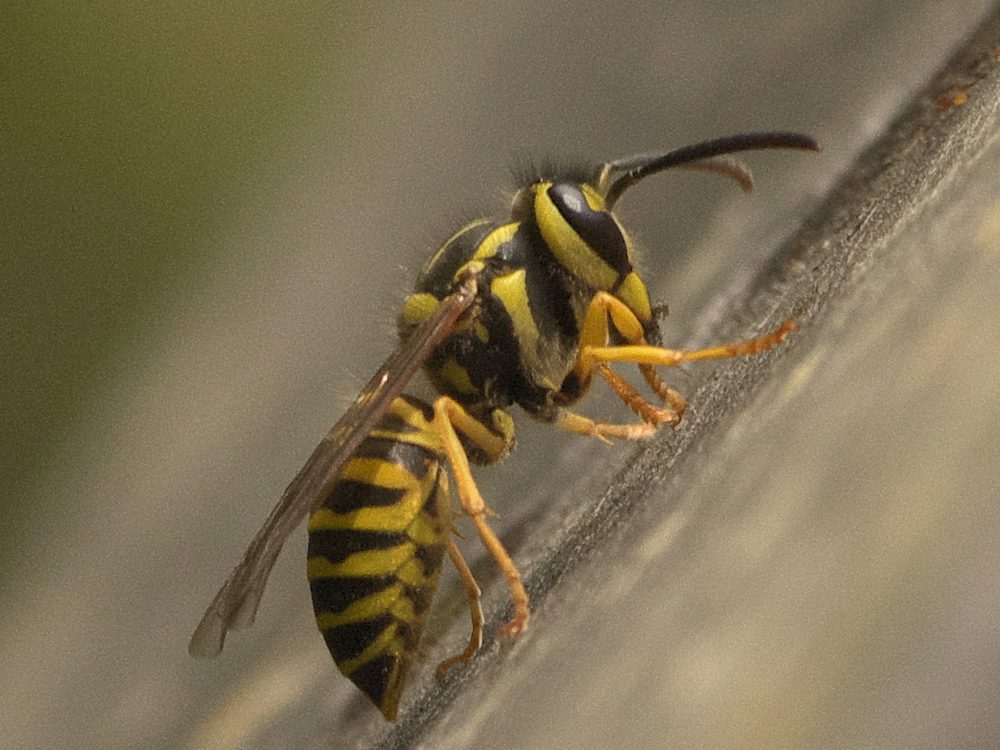
What's the fastest way to tell stinging insects apart?
Look at the nest, not the insect. An open umbrella of exposed cells hanging under an eave points to paper wasps; a football-shaped gray paper envelope points to bald-faced hornets; a hole in the ground or a void with steady traffic points to yellowjackets; a hard mud tube on a wall points to mud daubers.
Nest type is easier to observe safely from a distance than body markings, and it is the more useful clue for deciding what to do next. Yellow-and-black insects around a picnic are frequently called "wasps," "hornets" and "bees" interchangeably, but the nest usually settles the question.
Compare profiles in the Pest Library
What's the difference between a yellowjacket and a paper wasp?
Yellowjackets are shorter, stockier and more sharply patterned in yellow and black, and they nest in enclosed spaces — underground cavities, wall voids, or gaps in structures. Paper wasps are slimmer with long dangling legs in flight, and they build an open, exposed comb with no outer covering.
The behavior differs too. Paper wasps generally defend the area immediately around their comb and are otherwise not especially aggressive as they forage. Yellowjacket colonies are typically larger, defend an enclosed nest entrance vigorously, and become more noticeable in late summer when colonies peak and workers scavenge sweets and protein at outdoor food and trash.
What is a bald-faced hornet?
A large black-and-white social wasp — not a true hornet in the strict sense — that builds an enclosed gray paper nest, often football-shaped, in a tree, shrub, or against a structure such as a soffit or wall.
The nest is the giveaway: a closed papery envelope with a single entrance near the bottom. Colonies are generally defensive around that nest, and disturbing one, including with vibration from mowing or trimming nearby, can prompt a defensive response. Nests are usually inconspicuous early in the season and become obvious by late summer once they are large.
Bald-faced hornet profile
Are mud daubers dangerous?
Mud daubers are solitary wasps that are generally not defensive and rarely sting people. They build hard mud tubes or cells on walls, under eaves, in sheds and in other sheltered spots.
Because they are solitary, there is no colony to defend, which is why they behave very differently from yellowjackets even though they are wasps. Old mud nests are frequently found empty and can be scraped off. Their presence is usually a nuisance and appearance issue rather than a stinging risk.
Is that a carpenter bee, a bumble bee or a honey bee?
A large black-and-yellow bee hovering around eaves, railings, decks or fascia with a shiny, mostly hairless black abdomen is typically a carpenter bee. A fuzzy abdomen indicates a bumble bee. Honey bees are smaller, slimmer and amber-brown with darker banding.
- Carpenter bee — bores round holes roughly a half inch across into unpainted or weathered wood; males hover conspicuously but cannot sting
- Bumble bee — fuzzy body; nests in cavities, ground hollows or under structures; an important pollinator
- Honey bee — slim amber-brown body; lives in managed hives or established colonies with wax comb
Bed Bugs & Beyond treats carpenter bees. Honey bees and bumble bees are identification-only in our Pest Library — we do not treat or remove them. For a honey bee colony, contact a local beekeeper or the Alabama Cooperative Extension System for referral guidance.
Why does identification matter before anything is done?
It determines both the stinging risk and whether service is appropriate at all. Some of these insects are treated, some are beneficial pollinators we do not treat, and some are harmless once the nest is empty.
It also changes where the work is. A yellowjacket nest in a wall void is a structural problem needing careful handling; a paper wasp comb under a porch ceiling is visible and localized; carpenter bee activity is about the wood being bored rather than about a colony. Misidentifying a bumble bee nest as a yellowjacket nest, or a honey bee swarm as a wasp problem, leads to the wrong action.
Why shouldn't you disturb an active nest?
Social wasp and hornet colonies defend their nests, and disturbance can bring out many individuals at once. Stings can be serious for anyone with a sensitivity to insect venom.
- Do not knock down, spray, plug or burn an active enclosed nest
- Avoid nests around dusk and dawn as well as midday — activity varies but defense does not stop
- Watch for nests before mowing, trimming or pressure washing; vibration alone can prompt a response
- Keep children and pets away from a ground nest entrance you have located
- Note the nest's exact location from a distance and, if you can, photograph it safely
- Seek medical attention for a severe reaction or multiple stings
When is professional help appropriate?
When a nest is in or on a structure, near a door, walkway or play area, inside a wall or the ground where you cannot see its extent, or when anyone in the household has a known sensitivity to stings.
Late-summer nests are the most common reason for a call, because colonies are largest and most conspicuous then. We provide stinging insect service across Baldwin County and the Gulf Coast, with one-time and recurring options and no long-term contract required. Same-day service may be available depending on the day and the property.
Stinging insect control