

Pest Library
Mud Dauber
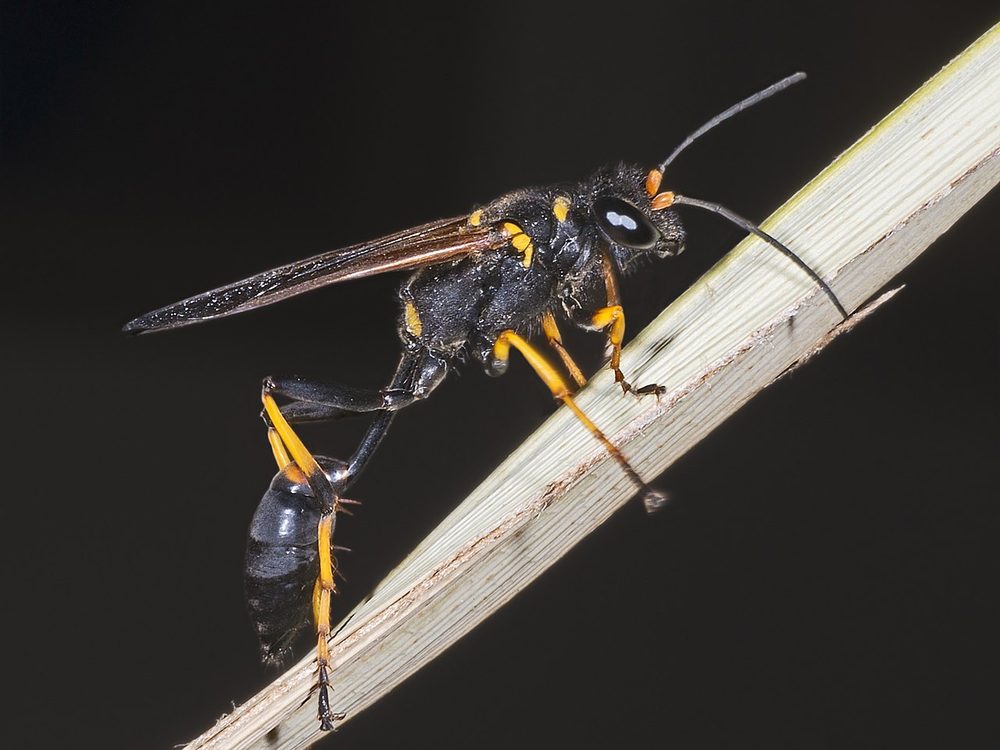
Mud daubers are slender solitary wasps with long thread-like waists that build mud tubes or clumped mud nests on walls, ceilings, sheds and under eaves. Because they are solitary rather than colony-forming, they defend nothing and almost never sting.
Profile
- Scientific name
- Sceliphron and Trypoxylon spp.
- Identification
- Long thin petiole between thorax and abdomen; black, metallic blue-black or black with yellow markings. Mud nests are the clearest sign.
- Typical size
- Adults about 1 inch.
- Behavior
- Females build and provision cells with paralyzed spiders, then seal them. Adults are not defensive.
- Habitat
- Sheltered walls, ceilings, garages, sheds, under decks and porch overhangs.
- Diet
- Nectar for adults; provisioned spiders feed the larvae.
- Lifecycle
- Cells are provisioned in warm months and adults emerge from the mud nest, leaving round exit holes.
- Why it matters
- Mostly a cosmetic and staining nuisance. Abandoned nests can attract other insects, and mud tubes on a foundation should not be confused with termite mud tubes.
- DIY considerations
- Physical removal and washing is usually all that is needed.
- Professional considerations
- Service removes nests and addresses the spider population supporting them, plus perimeter treatment where nesting is heavy.
Signs of activity
- Mud tubes or lumpy mud nests attached to walls and ceilings
- Round exit holes in older mud nests
- Spider remains and mud debris beneath nest sites
Prevention
- Scrape and wash mud nests off surfaces early in the season
- Reduce spider populations that provide the food supply
- Keep garages and sheds closed during peak building season
Sources
Related information
Seeing mud dauber at your property?
Book online or request service through our secure customer portal. Tell us what you are seeing and where the property is located.